Salsa criolla is a fresh Latin American onion relish, and it comes in two distinct traditions worth knowing apart. The Peruvian version is built on red onion, lime and ají amarillo, sliced thin and served raw. The Argentinian version is a diced vegetable vinaigrette, dressed in red wine vinegar and olive oil. Both turn up constantly at the table:
- Draped over grilled meats and asado
- Spooned onto ceviche, fried fish or sandwiches
- Tucked inside or alongside empanadas
Key Takeaways
Salsa criolla’s authenticity rests on technique, onion cut, soak time and resting, rather than a fixed ingredient list.
| Point | Details |
|---|---|
| Two distinct styles | Peruvian salsa criolla uses red onion, lime and ají; Argentinian uses diced vegetables in a vinegar dressing. |
| Soak, don’t skip | Soaking sliced red onion in cold water for 5 to 10 minutes removes harsh sharpness while keeping crunch. |
| Rest before serving | Both styles need 10 to 30 minutes resting so acid can soften the raw vegetables and meld flavours. |
| Short shelf life | Refrigerate in an airtight container and use within 2 to 3 days; freezing ruins the texture. |
| Cut matches purpose | Pluma strips suit the Peruvian style’s raw crunch; fine brunoise dice suits the Argentinian style’s cling to grilled meat. |
Table of Contents
- What is salsa criolla, really?
- How do you make Peruvian salsa criolla?
- How do you make Argentinian salsa criolla?
- Kitchen fixes and ingredient swaps
- How long does salsa criolla keep?
- What do you serve salsa criolla with?
- Why trust this recipe
- Is salsa criolla healthy?
- How other Latin American cuisines adapt salsa criolla
- Our take on getting salsa criolla right
- Sources
- FAQ
What is salsa criolla, really?
The name itself tells the story. “Criolla” doesn’t point to one fixed recipe. It signals a home style, born from local ingredients and passed down through kitchens rather than cookbooks. That’s why the dish looks so different depending on which side of South America you’re standing on.
Salsa criolla shows up across Peru, Argentina and Uruguay, and it plays a genuinely different role in each. In Peru, it’s a bright, acidic counterpoint to rich seafood and fried food. In the Río de la Plata region, it’s closer to a table relish for grilled meat, built more like a vinaigrette with diced vegetables than a raw onion salad.
One common misconception: tomato is not a mandatory ingredient. It’s typical in the Argentinian style, but the Peruvian classic skips it entirely, leaning instead on:
- Red onion as the base
- Lime juice for acidity
- Ají amarillo for colour and gentle heat
How do you make Peruvian salsa criolla?
This is the version most closely tied to ceviche houses and Lima’s anticuchería stalls, and it’s the one we lean on at Senor Empanada when we want a sharp, citrus-forward garnish. The magic is in the cut and the timing, not a long ingredient list.
Ingredients (serves 4 as a garnish):
- 2 medium red onions, sliced into thin strips (the classic “pluma” cut, named for its resemblance to feathers)
- 1 to 2 ají amarillo peppers, deseeded and finely sliced (or 1 tablespoon jarred ají amarillo paste)
- Juice of 2 limes
- 1 tablespoon extra virgin olive oil
- Salt to taste
- A small handful of chopped coriander (optional but traditional)
Method:
- Slice the onions into thin pluma strips, then soak them in cold water for 5 to 10 minutes. This step pulls out the harsh sulphur compounds that make raw onion bite back, without turning the onion soft or waterlogged.
- Drain thoroughly and pat dry. Wet onion dilutes the lime juice and waters down every other flavour in the bowl.
- Combine the onion, ají amarillo, lime juice, olive oil and salt in a bowl. Toss gently.
- Rest the salsa for 10 to 30 minutes before serving. The lime softens the onion’s rawness and lets the ají’s heat settle in rather than sit on top of everything.
- Taste and adjust. If it tastes flat, it usually needs more salt, not more lime.
Ají amarillo isn’t always easy to find outside specialty grocers. Jarred ají amarillo paste is a solid substitute and keeps the colour and fruity heat intact. In a pinch, a small amount of mild yellow chilli or a well-seeded jalapeño gets you close, though it won’t have quite the same fruitiness.
Pro Tip: Don’t skip the soak. Onion straight off the knife is genuinely sharper on the palate than onion that’s had ten minutes in cold water. It’s a small step that makes the difference between a salsa that bites and one that sings.
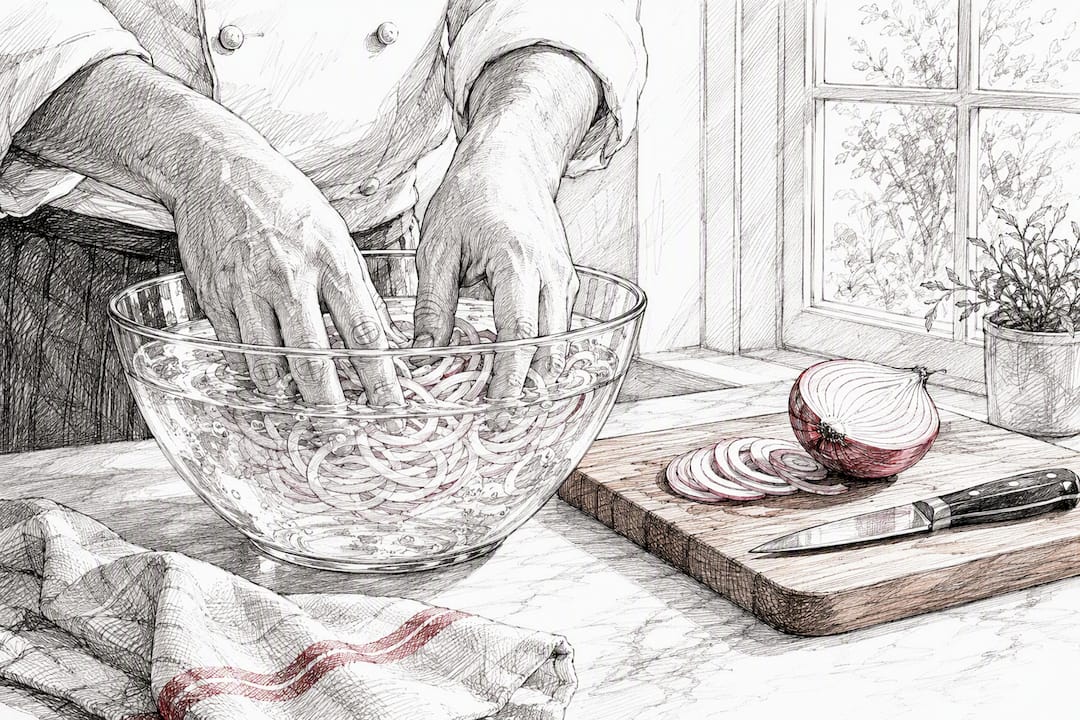
Home cooks who’ve made the switch to the pluma cut and a proper soak often notice the salsa keeps its crunch far longer than a rough chop does, even after resting.
How do you make Argentinian salsa criolla?
This is the rioplatense version, the one you’ll find sitting on the table at any parrilla alongside a bottle of Malbec and a pile of grilled short ribs. It’s less about heat and more about acidity and crunch, built as a diced vegetable vinaigrette rather than a raw onion salad.
Ingredients (serves 4 to 6 as a condiment):
- 1 medium onion, finely diced
- 1 red bell pepper, finely diced
- 1 green bell pepper, finely diced
- 1 large tomato, seeded and finely diced
- 3 tablespoons red wine vinegar
- 4 tablespoons extra virgin olive oil
- Salt and pepper to taste
Method:
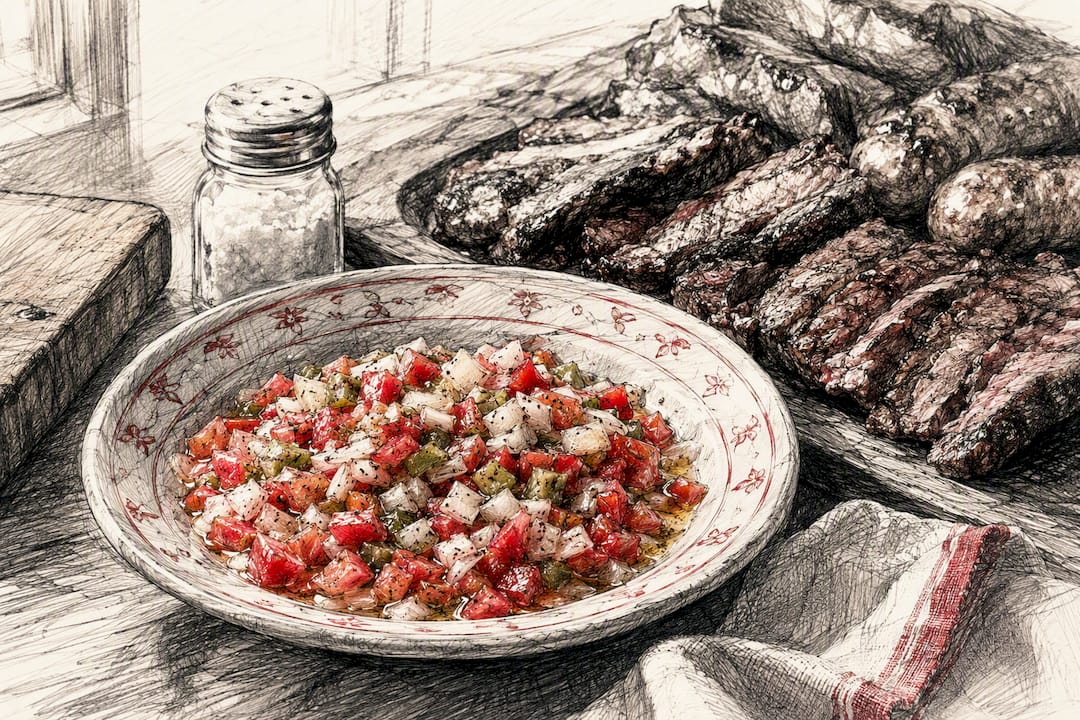
- Dice the onion, peppers and tomato into a fine, even brunoise. This is where the Argentinian style diverges hardest from the Peruvian one. Uniform small dice gives the salsa a texture that clings to a slice of grilled meat rather than sliding off.
- Whisk the red wine vinegar and olive oil together in roughly a 1:1.3 ratio, so the acidity comes through without being aggressive.
- Combine the diced vegetables with the dressing. Season with salt and pepper.
- Let it sit for a short time before serving so the vinegar softens the raw onion and pepper, so the vinegar has time to soften the raw onion and pepper.
Pro Tip: Cut everything the same size. A salsa criolla with uneven dice looks careless on the plate and eats unevenly too, a mouthful of tomato followed by a chunk of raw pepper. Aim for pieces roughly the size of a grain of rice.
This version is the classic partner for asado, and it holds its own next to chimichurri on a grilled meat platter. Where chimichurri brings herbs and garlic, salsa criolla brings crunch and acid, and most Argentinian tables serve both.
Kitchen fixes and ingredient swaps
Most salsa criolla problems trace back to one of two things: onion handling or heat balance. Fix those and everything else falls into place.
- Soaking mellows onion without cooking it; rinsing alone barely touches the sharpness.
- For less heat, remove the ají or pepper seeds and white pith entirely, since that’s where most of the capsaicin sits.
- No ají amarillo on hand? A small amount of mild yellow chilli plus a pinch of turmeric gets close to the colour and gentle warmth, though the flavour won’t be identical.
- Keep the Peruvian version citrus-led and light on oil if you want it to stay bright and almost pickled in character. Add a touch more olive oil if you prefer a rounder, softer mouthfeel.
- For the Argentinian style, taste the vinegar-to-oil balance before adding salt. Too much vinegar and it turns sharp rather than lively.
Pro Tip: If your salsa tastes one-note, it’s rarely the ingredients, it’s the balance. A pinch more salt often does more than another squeeze of lime.
How long does salsa criolla keep?
Salsa criolla is best treated as a short-life condiment, not a pantry staple.
- Store both styles in an airtight container in the fridge.
- Peruvian salsa criolla keeps for a few days, though the onion softens and the lime’s brightness fades by day two.
- Argentinian salsa criolla also keeps for a few days, but the vegetables lose their crisp edge as the vinegar keeps working on them.
- Freezing isn’t recommended for either style. Raw onion and pepper turn watery and limp once thawed, and the texture never recovers.
- Resting for 10 to 30 minutes before serving is different from long storage. That short window mellows sharpness without breaking the vegetables down, so make it fresh and let it sit briefly rather than making it days ahead.
What do you serve salsa criolla with?
The classic pairings are worth knowing, but salsa criolla has earned a place well beyond its traditional table.
- Peruvian style: ceviche, pan con chicharrón, tamales, and grilled or fried fish
- Argentinian style: asado, choripán, and empanadas straight from the oven
- As a garnish, 1 to 2 tablespoons per person is plenty
- As a side salad, aim for 30 to 50 grams per person
Beyond the traditional plate, both versions work well scattered over tacos, folded through a grain bowl, tossed into a green salad, or spooned over grilled fish fillets. A house-made salsa like this one adds a freshness that jarred condiments rarely match, and that difference in a home kitchen is one reason so many cooks keep coming back to making it from scratch.
Why trust this recipe
Senor Empanada has spent years working with Latin American fillings, sauces and pantry staples, and salsa criolla is a fixture in that kitchen because it’s one of the few condiments that genuinely improves a dish rather than just decorating it.
- We test technique details like onion cut and soak time against traditional methods, not shortcuts.
- Our pantry guide to Latin flavours and spices covers ají paste, vinegar and oil choices in more depth.
- Fresh limes and a decent extra virgin olive oil matter more than any other ingredient here. Bottled lime juice and cheap oil flatten the whole dish.
- Pair your salsa criolla with our authentic empanada recipes for a proper Latin spread.
Is salsa criolla healthy?
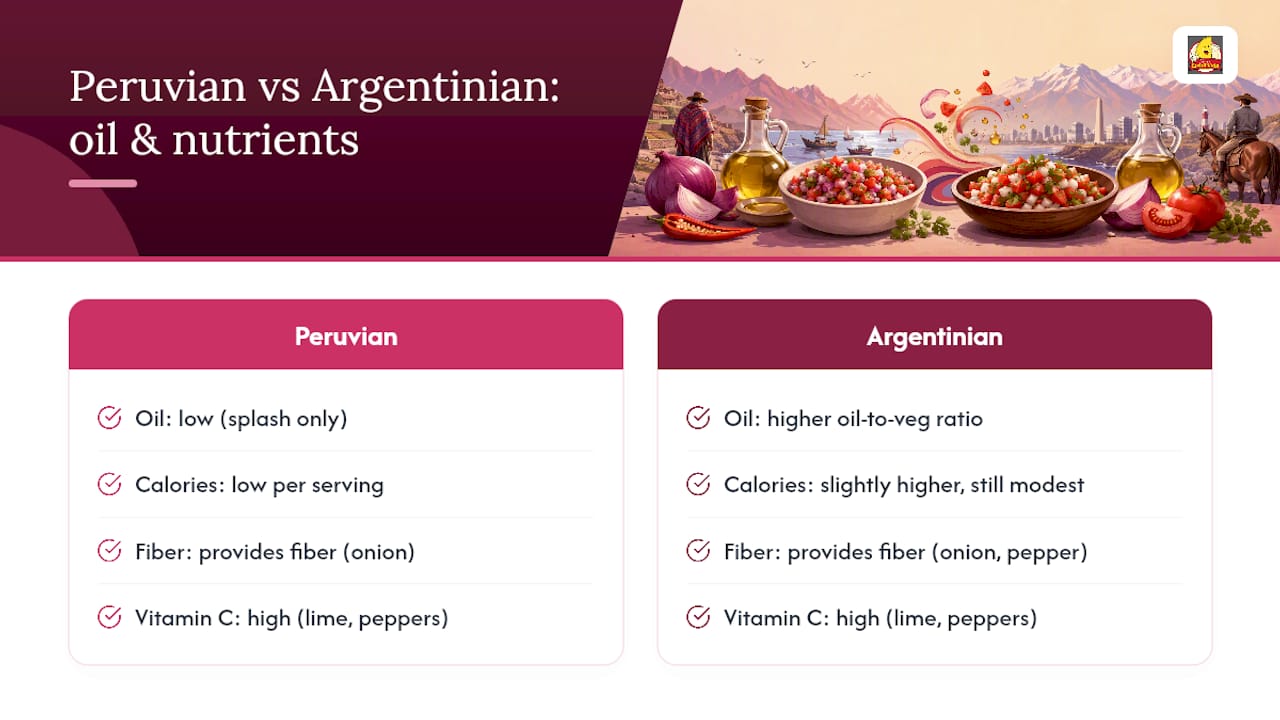
Salsa criolla is a genuinely light condiment, built almost entirely from vegetables, citrus and a small amount of oil. A typical serving of the Peruvian style, heavy on onion and lime with only a splash of oil, sits low in calories and carries no dairy, gluten or animal protein, making it naturally suited to vegan, vegetarian and gluten-free diets.
The Argentinian style carries slightly more fat because of the higher oil-to-vegetable ratio in the dressing, though it’s still a modest amount per serving compared to creamy sauces or dressings. Onion and bell pepper both bring fibre and vitamin C to the plate, and lime juice adds a further hit of vitamin C without any sugar.
For anyone watching sodium, the main lever is salt added by hand, since neither style relies on processed or preserved ingredients. Cutting back on added salt, or seasoning at the table rather than in the bowl, is the simplest way to bring sodium down without losing flavour.
The one caution worth flagging is ají amarillo and other chilli varieties. They’re not an allergen in the formal sense, but anyone sensitive to capsaicin should start with less than the recipe calls for and taste as they go. Raw onion in large quantities can also sit heavily with people prone to reflux, so the resting time isn’t just about flavour. It gives the onion a chance to mellow before it hits a sensitive stomach too.
How other Latin American cuisines adapt salsa criolla
Salsa criolla isn’t locked to Peru and Argentina. Variations of the same idea, thin-cut onion, acid, a touch of chilli, turn up across the region under different names and with local tweaks.
In Uruguay, the style closely mirrors the Argentinian version, a diced vegetable relish that rides alongside grilled meat at any asado. Chile has its own close cousin in pebre, which swaps in coriander, garlic and sometimes tomato, dressed with oil and a splash of vinegar or lemon. Ecuador’s version leans on curtido-style pickled onion with lime and a mild local chilli, often served over ceviche in a way that echoes the Peruvian approach but with its own regional chilli character.
Central American kitchens, particularly in Honduras and El Salvador, use a pickled cabbage and onion relish called curtido that shares salsa criolla’s core logic: raw vegetables, acid, and a short rest to soften the bite. It’s not the same dish, but the technique, cut thin, soak or pickle, dress with acid, rest before serving, clearly comes from the same family tree.
What ties all of these together is technique rather than a fixed ingredient list. The onion cut, the acid balance and the resting time matter more than whether the recipe calls for coriander, tomato or a particular chilli. That flexibility is exactly why salsa criolla has survived and adapted across so many kitchens without losing what makes it work.
Ready to put your salsa criolla to work? It’s the perfect partner for a batch of freshly baked empanadas. Explore Senor Empanada’s authentic empanada recipes for the ideal pastry to pair it with, or check our where to buy guide if you’d rather skip the dough-making and go straight to the good stuff.
Our take on getting salsa criolla right
Most recipe sites treat salsa criolla as one dish with regional “variations,” and that framing undersells both traditions. Peruvian and Argentinian salsa criolla aren’t variations on a theme. They’re two separate condiments that happen to share a name and a base ingredient. Treating them as interchangeable is where most home cooks go wrong, reaching for a squeeze of lime when a dish actually calls for a vinegar dressing, or vice versa.
The conventional advice also underplays technique in favour of ingredient lists. A recipe that nails the pluma cut and the soak time but skips the ají will still taste more authentic than one with every listed ingredient and a rushed rough chop.
If we had to prioritise one thing for a first attempt, it’s the onion handling, cut, soak, drain. Get that right and both recipes become forgiving of small substitutions. Get it wrong and no amount of lime or vinegar fixes a salsa that’s fighting you on texture.
— Senor Empanada
Sources
- Salsa criolla — Wikipedia (es)
- Salsa criolla peruana casera. Receta fácil y refrescante al estilo peruano — ABC Recetas
- Eatperu
- Salsa criolla recipe (Argentinian salsa) — Chili Pepper Madness
FAQ
What is salsa criolla sauce made of?
Peruvian salsa criolla is made from thinly sliced red onion, lime juice, ají amarillo and a touch of olive oil. Argentinian salsa criolla is diced onion, bell pepper and tomato dressed with red wine vinegar and olive oil.
Is salsa criolla spicy?
The Peruvian version carries mild to moderate heat from ají amarillo, which you can reduce by removing the seeds and pith. The Argentinian version isn’t spicy at all, since it relies on vinegar and oil rather than chilli.
What is salsa criolla called in English?
There isn’t a direct English name. It’s usually described as a “creole onion relish” or “onion salsa,” though most English-language recipes simply keep the Spanish name.
What are the ingredients in Peruvian salsa criolla?
Red onion, lime juice, ají amarillo (or a jarred paste substitute), a small amount of extra virgin olive oil, salt, and often fresh coriander. It’s soaked, dressed and rested for 10 to 30 minutes before serving.